Buying psyllium for baking is a different decision than buying it for the medicine cabinet. A supplement buyer cares about dose and mixability; a baker cares about grind, purity, and — above everything — whether the loaf comes out of the oven bread-colored or purple.
As a note on transparency: this article contains affiliate links, and we may earn a commission if you buy through them, at no extra cost to you.
This review ranks psyllium products by baking criteria specifically, explains the purple-bread problem that drives most brand-switching, and includes a 60-second test for vetting any brand before you waste a loaf on it.
What Makes a Baking Psyllium Different
Color Stability: Some psyllium powders turn a bake grey-purple — harmless, flavor-neutral, and completely demoralizing. The effect is commonly attributed to pigments in the husk reacting with alkaline leaveners, though bakers report it inconsistently enough that no single explanation accounts for every case. What is reliable is the pattern: it happens with powder far more than whole husk, it varies by brand and batch, and acid mitigates it. This is the number one baking-specific criterion.
Grind and Form: Fine powder distributes evenly in batters and flatbreads; whole husks give yeasted loaves a slightly more open crumb, which is why many experienced bread bakers prefer them. Our powder versus whole husk guide covers the conversion between the two, which is not one-to-one by weight.
Purity: Baking psyllium must be plain — no sweeteners, flavors, or additives. Flavored supplement blends have ruined more gluten-free loaves than any technique error. For celiac households, batch-tested or certified gluten-free matters too, since psyllium can pick up cross-contamination in processing.
Price Per Gram: A single bread loaf uses 20 to 40 g of psyllium — a week of supplement doses in one bake. Bakers should buy bulk sizes, and the per-gram price matters here more than anywhere else on this site.
The Picks at a Glance
| Pick | Form | Best For |
|---|---|---|
| Anthony’s Organic Psyllium Husk Powder | Fine powder, 1.5 lb | Best all-around baking powder |
| Anthony’s Organic Whole Psyllium Husks | Whole husk, 1.5 lb | Best for yeasted bread |
| Terrasoul Organic Psyllium Husk Powder | Superfine powder, 1 lb | Markets on color stability |
| NOW Psyllium Husk Powder | Fine powder | Widely available standard |
| Viva Naturals Organic Psyllium Powder | Fine powder, 24 oz | Bulk organic value |
Best All-Around Baking Powder: Anthony’s Organic Psyllium Husk Powder

Anthony’s hits every baking criterion at once: USDA organic, batch-tested gluten-free (the certification that matters in a celiac kitchen), finely ground for even distribution, nothing added — and sold in a 1.5-pound bag priced for people who bake weekly rather than dose daily. It’s the same brand whose whole husks lead our main supplement roundup, and the powder carries the identical clean-label standard.
Downsides: Like most standard powders, color performance can vary by batch — run the 60-second test below before committing a loaf, and keep an acid trick in reserve.
Best for Yeasted Bread: Anthony’s Organic Whole Psyllium Husks
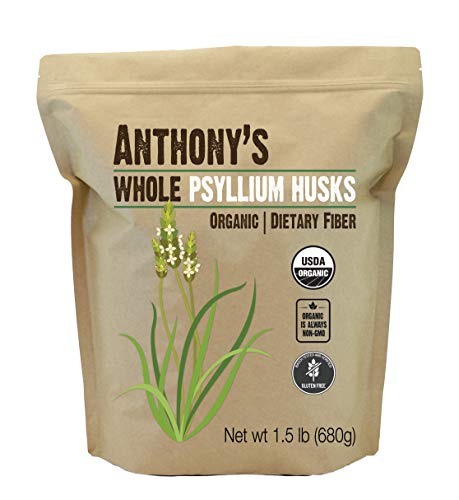
Serious gluten-free bread bakers widely prefer whole husks: the coarser flakes hydrate into a softer gel that many find gives a lighter, more open crumb, and whole husks are far less prone to the purple reaction. Anthony’s whole husk version brings the same organic, batch-tested, additive-free spec as the powder in a bread-baker’s quantity.
Downsides: Whole husks hydrate slower (build in the rest time our baking guide describes), can leave visible flecks in delicate batters and smooth flatbreads, and need a weight conversion when a recipe specifies powder.
Markets on Color Stability: Terrasoul Organic Psyllium Husk Powder

Terrasoul is the one brand in this group that makes color stability part of its product positioning rather than leaving it to chance, alongside a superfine grind that is genuinely excellent in tortillas and smooth batters. If you have pulled a lavender loaf from the oven and sworn never again, this is the pick that at least puts the manufacturer on record about it.
Downsides: The 1-pound bag runs pricier per gram than Anthony’s, availability fluctuates more than the bigger brands, and a marketing claim is not a guarantee — run the test on your first bag regardless.
Widely Available Standard: NOW Psyllium Husk Powder
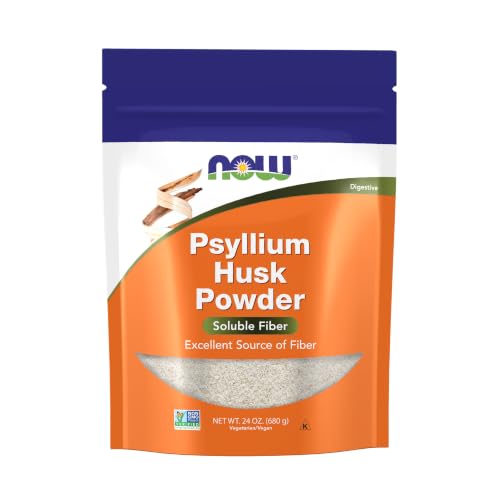
NOW is a GMP-certified manufacturer with more than 50 years in supplements, and its psyllium powder is plain, fairly priced, and stocked almost everywhere — which matters when you run out mid-recipe. It is the low-friction choice, and the same brand appears in our capsules review.
Downsides: It is conventional rather than organic, if that matters to your pantry, and bakers do report batch-to-batch color variation with it as with other standard powders — this is not the pick if a guaranteed neutral bake is your priority.
Bulk Organic Value: Viva Naturals Organic Psyllium Powder
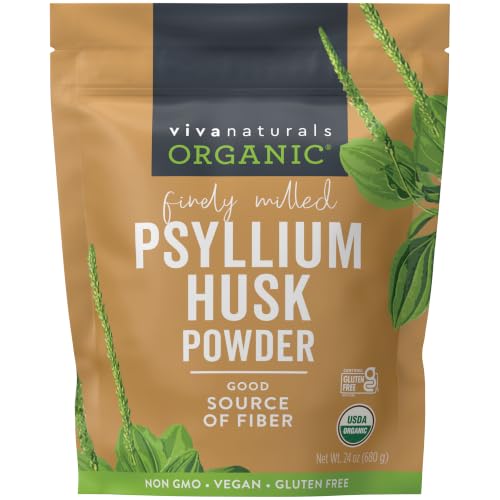
For households where psyllium bread is a weekly staple, Viva’s 24-ounce organic bag delivers a strong organic price per gram, finely ground and explicitly positioned for gluten-free baking, smoothies, and juices.
Downsides: Less baking-community track record than NOW or Anthony’s — run the test below on your first bag.
The 60-Second Purple Test
Before trusting any new bag with a loaf, test it in a glass:
- Stir 1 teaspoon of the psyllium into half a cup of warm water with a pinch of baking soda.
- Wait two minutes for the gel to form.
- Check the color. A grey, mauve, or purple cast in the glass is a strong signal you will see the same tint in a bake using baking soda or baking powder. A tan, neutral gel is a good sign.
The test is a useful screen rather than a guarantee, since bakers report the effect appearing inconsistently even within a single bag. If a bag fails, it is not wasted: use it in yeasted breads, which contain no chemical leavener, or add roughly ¼ teaspoon of lemon juice or vinegar per tablespoon of psyllium in leavened recipes. Our recipe hub covers the troubleshooting in more detail.
Can You Bake With Supplement Psyllium?
Yes — if it’s plain. Unflavored, additive-free supplement psyllium and “baking” psyllium are the same ingredient, and every pick above works in both roles. What never belongs in dough: flavored or sweetened products like orange Metamucil (sweeteners and flavors wreck bakes), and capsules, which are an expensive way to buy small amounts of powder you’d have to crack open anyway — our capsules vs. powder comparison runs that math.
One kitchen-to-body note: baked-in psyllium is still psyllium. The grams count toward daily fiber intake, water matters through the day, and anyone with swallowing difficulties or on absorption-sensitive medications should apply the same care as with a supplement — the details are in our interactions guide.
How We Chose
Baking criteria, in order: purity (plain husk only, with gluten-free testing weighted for celiac safety), grind quality for the form’s intended use, bulk pricing per gram, consistency of supply, and what each manufacturer is willing to state about color. We have not lab-tested these products for color stability, and we say so rather than implying a test we did not run — the glass test below is how you check your own bag.
The Bottom Line
Anthony’s powder is the best baking psyllium for most kitchens — organic, batch-tested, finely ground, and priced in baker quantities — with their whole husks the pick for yeasted loaves chasing an open crumb. Terrasoul is worth the premium if you want a manufacturer that addresses color directly, NOW is the one you can always find, and Viva feeds the high-volume bakers.
Whichever bag you buy, run the glass test first, weigh your doses, and the loaf math takes care of itself.