Psyllium is a simple supplement that people get wrong in predictable ways — too little water, dry powder on food, capsules for a job they cannot do, and doses timed against their own medications.
This guide covers the three forms of psyllium husk, the honest math on capsules, exactly how to mix and take the powder, and the mistakes that account for most bad first experiences.
As a note on transparency: this article contains affiliate links, and we may earn a commission if you buy through them, at no extra cost to you.
Start Here
- Water: At least 8 oz per dose, stirred briskly and drunk within about 30 seconds.
- Ramp: Start at one rounded teaspoon daily and hold there for several days.
- Medications: Keep every dose at least two hours from oral drugs.

The Default Choice
Anthony’s Psyllium Husk Powder
Single ingredient, unflavored, and cheap enough per gram that a therapeutic dose is not a budget decision. Powder is the form that suits most goals; the section below covers when it isn’t.
We may earn a commission from links in this box. Price last checked 2026-10-02.
The Three Forms, and What Actually Differs
Psyllium comes as whole husk, ground powder, and capsules. The fiber is identical; the practicalities are not.
Powder: The default for a reason — it disperses fastest in water, drinks smoothest, and costs the least per gram. Fine powders gel a bit quicker than coarse ones, so stir and drink without delay.
Whole husk: Slightly coarser texture, slightly slower to gel, and prone to clumping if you pour it into standing water and hesitate. Some people prefer the texture; functionally it matches powder. Our powder versus whole husk comparison covers the details.
Capsules: Convenient, tasteless — and the form where honest math matters. A typical capsule holds about 0.5 g of psyllium, so it takes roughly 4 to 6 capsules to match one teaspoon of powder. For regularity at 5 g a day, that is manageable. For the cholesterol-level doses used in trials — the FDA’s authorized heart-health claim is built around 7 g of soluble fiber daily, or roughly 10 g of psyllium husk — you are looking at 16 or more capsules daily, at several times the cost of powder. Capsules suit travel, texture aversion, and small top-up doses; powder suits therapeutic doses. Our capsules vs. powder comparison runs the full cost and dose math, and our capsule picks cover the products worth buying if capsules are your format.
Whatever the form, the water rule is the same: capsules swell after swallowing just like powder, so they need the same full glass, not a sip.
The table below puts the three side by side. Pay attention to the capsule count in particular — a bottle that looks inexpensive on the shelf empties fast at a therapeutic dose.
| Fine Powder | Whole Husk | Capsules | |
|---|---|---|---|
| Product |
Anthony’s Psyllium Husk Powder, 1.5 lb
|
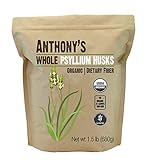 Anthony’s Whole Psyllium Husks, 1.5 lb
|
 Yerba Prima Psyllium Caps, 400 × 625 mg
|
| Texture | Gels fast; short drinking window | Gels slower; easier to tolerate | No texture at all |
| Dosing precision | High — scoops consistently | Moderate — settles unevenly | Highest — fixed per capsule |
| Reaching 10 g/day | About 2–3 tsp | About 3–4 tbsp | Roughly 16 capsules |
| Price | $26.49 | $25.49 | $29.97 |
| Best for | Daily therapeutic dosing | Texture sensitivity, baking | Travel, top-up doses |
| Buy on Amazon | Buy on Amazon | Buy on Amazon |
Prices and availability update automatically; last checked 2026-10-02. We may earn a commission from links in this table.
How to Take Psyllium Powder
The technique is short enough to learn in one glass, and getting it right removes most of the reasons people quit.
- Measure your dose — about 5 g, one rounded teaspoon, to start. Use the product’s scoop or a measuring spoon, not a guess.
- Pour at least 8 ounces (240 ml) of water or another thin liquid into a glass first, leaving stirring room.
- Add the psyllium to the liquid (not the reverse — it clumps less this way) and stir briskly for a few seconds.
- Drink it immediately, before it thickens. Psyllium starts gelling within a minute or two.
- Follow with another half to full glass of water.
If it ever gels in the glass before you finish, add more liquid and stir rather than spooning down the thick remainder. And never take psyllium powder dry — it can swell in the throat, which is the mechanism behind its labeled choking warning.
If stirring never quite gets you a clump-free glass, a shaker bottle with a wire whisk ball disperses the powder faster than a spoon can. It is a small fix that solves most texture complaints.
What to Mix It Into
Water is the baseline, but anything thin and drinkable works: diluted juice, cold herbal tea, or a smoothie blended just before drinking — our smoothie recipes are built for exactly this. Cold and cool liquids buy you more drinking time; hot liquids speed up gelling.
Two mixing choices to be skeptical of. Thick liquids like kefir or drinkable yogurt gel fast and can turn unpleasant mid-glass. And sprinkling dry psyllium over food — oatmeal, salads, yogurt — is popular but flawed: the psyllium hydrates from your food’s moisture and your saliva rather than a proper volume of water, the dose is hard to track, and slow eating gives it time to thicken where you do not want it. If you want psyllium in food rather than a glass, cook it in properly instead.
Taking It With Food: The Baking Route
Psyllium incorporated into recipes is fully hydrated during preparation, which solves the sprinkling problem. It is the structural backbone of gluten-free baking, binds keto bread, and works as an egg substitute. Count baked-in grams toward your daily total, and keep drinking water alongside — the fiber still needs it in your gut. Our recipe hub covers the kitchen side, and our baking picks rank products on grind and purity for exactly this use.
Whole husk is usually the better choice here. Its coarser structure holds up in doughs and batters where fine powder can turn gummy.
Getting the Dose and Schedule Right
Start at about 5 g once daily and hold there for several days before adding a second dose — the gradual ramp is what prevents the gas and bloating that make people quit in week one. Most goals land between 5 and 15 g per day, split into two or three doses; the full breakdown by goal is in our dosage guide.
The Dose Threshold Is Real: A GRADE-assessed meta-analysis of 19 randomized trials found that psyllium significantly lowered fasting blood sugar, HbA1c, and insulin resistance — but subgroup analysis showed doses under 10 g/day were not significantly associated with HbA1c improvement (Gholami et al., 2024). Underdosing is a common reason psyllium underperforms for metabolic goals.
Timing depends on what you are taking it for — any consistent time for regularity, with meals for cholesterol, before meals for blood sugar — and our timing guide covers each. One rule outranks all of it: keep every psyllium dose at least two hours from oral medications, since the gel can slow drug absorption. Details in our drug interactions guide.
Morning Versus Night Matters Less Than You Think: A randomized crossover study compared 12.7 g/day taken at breakfast against the same dose at bedtime over 8-week periods and found no difference between them (Van Rosendaal et al., 2004). Pick the slot you will actually keep.
The Mistakes That Cause Most Problems
Most of these are small, and most are invisible unless you go looking for them.
Too little water: The number one error, responsible for everything from paradoxical constipation to the rare serious obstruction cases. A full glass per dose is the floor, not the target.
Starting at full dose: Jumping straight to three daily servings is the fastest route to a week of bloating and an abandoned canister.
Letting the glass sit: Mix when ready to drink, not in advance.
Judging results in two days: Regularity effects take one to three days; cholesterol and blood sugar effects take weeks of consistency. Our guide on how long psyllium takes to work sets honest expectations.
Buying by form instead of by goal: If your target dose is therapeutic, capsule economics quietly work against you.
When to See a Doctor
How-to questions occasionally reveal situations that need medical input first. Check with a doctor or pharmacist before starting if:
- You have difficulty swallowing, or any history of bowel obstruction, gut narrowing, or GI surgery
- You take prescription medications and have not mapped the two-hour gap into your day
- You are giving psyllium to a child — see our guide on psyllium for kids first
- Swallowing psyllium ever feels like it catches or sticks, which is a stop-and-get-checked sign, not a push-through one
And if digestive symptoms persist beyond two weeks of correct use, the answer is evaluation, not a bigger dose.
Persistent problems can stem from medication side effects, pelvic floor dysfunction, slow transit, or another underlying condition. More fiber is not always the answer.
The Bottom Line
Powder in a full glass of water, stirred and drunk immediately, starting at one rounded teaspoon a day: that is the whole technique, and it covers most people. Capsules trade cost and capsule-count for convenience and make sense mainly at low doses; food routes work when the psyllium is cooked in, not sprinkled on.
Get the water right, ramp up slowly, and keep it two hours from your medications — the rest is preference.
Further Reading
- Psyllium (MedlinePlus, National Library of Medicine)
- Jovanovski E, et al. Effect of psyllium fiber on LDL cholesterol and alternative lipid targets: meta-analysis of 28 RCTs (median dose 10.2 g/day). Am J Clin Nutr, 2018
- Gholami Z, et al. The effect of psyllium on fasting blood sugar, HbA1c, HOMA IR, and insulin control. BMC Endocr Disord, 2024
- Van Rosendaal GMA, et al. Effect of time of administration on cholesterol-lowering by psyllium. Nutr J, 2004
- 21 CFR 101.81 — Health claims: Soluble fiber from certain foods and risk of coronary heart disease
- Dietary fiber: essential for a healthy diet (Mayo Clinic)